

Page History
...
The process flows for all new UI actions have been documented and need to be reviewed, and several additional flows are still pending and will have to be updated later in this document.
...
Architectural changes w.r.t UI
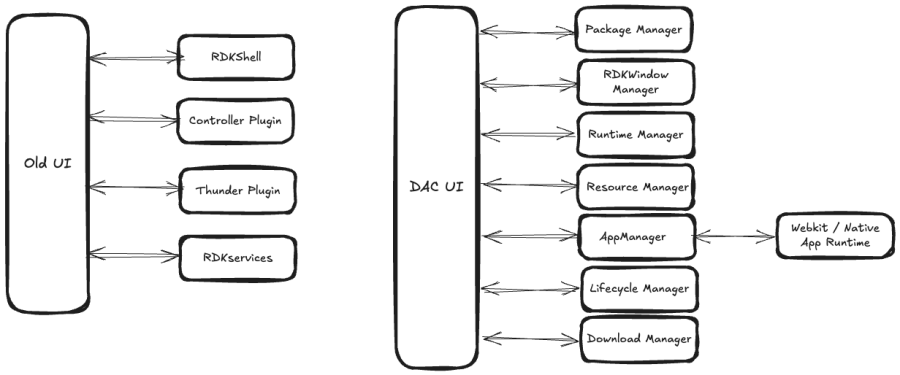
With the introduction of AI 2.0 and the DAC-based architecture, the design and operation of the new UI and associated applications will change significantly. All applications—including the UI—will now be delivered as DAC app bundles (Bolt packages). The UI will be shipped as a preinstalled bundle, while all other applications can be downloaded and installed by the user as needed. Some of the major change include:
...
The diagram (mentioned below) illustrates the shift from the old UI architecture to the new AI 2.0 / DAC architecture. This is not a process flow diagram; rather, it provides a high-level conceptual mapping.
...
Default Default Home Page – A Look
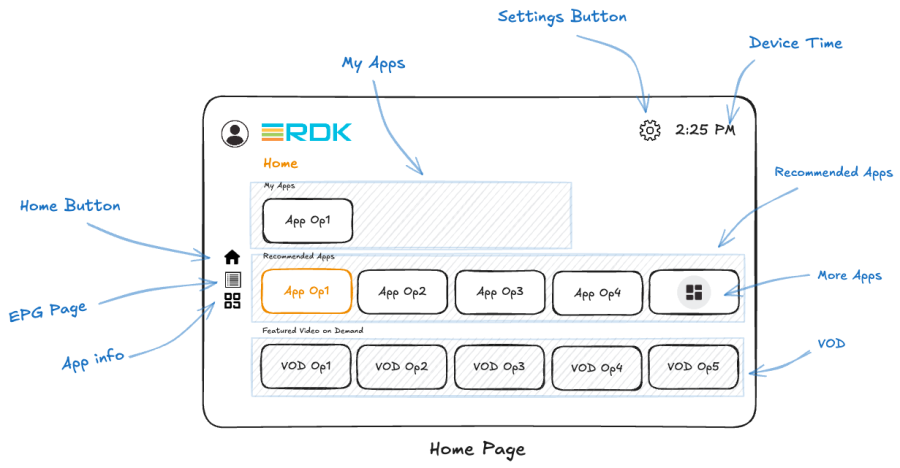
The Home Page of the restructured UI appears as shown above.
...
Note: The VoD row is expected to use the platform player like AAMP. However, in a DAC based environment, this is not still be entirely functional.
...
Overlay/Modal Types
...
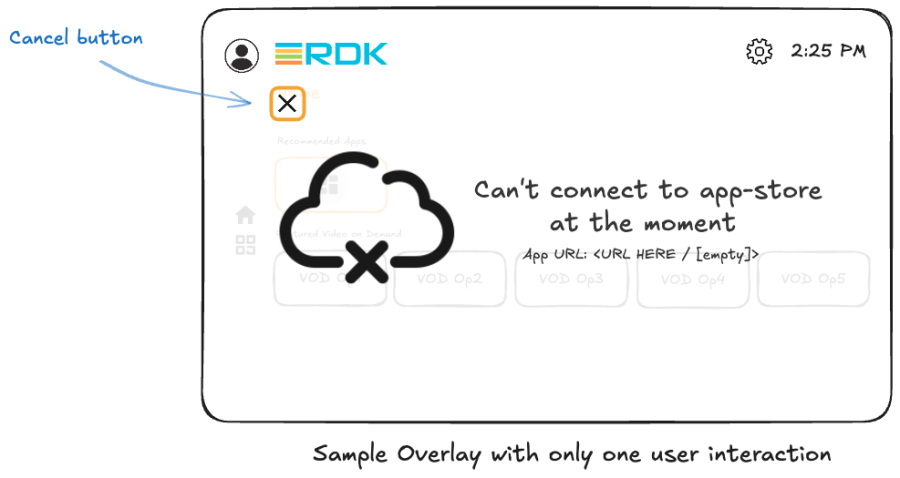
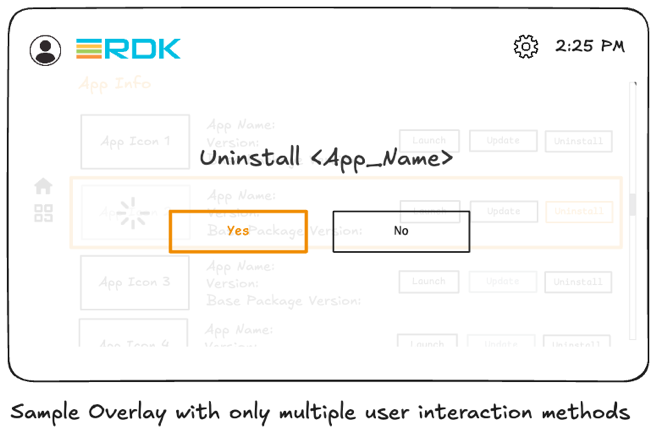
- Another feature required for the DACsupporting UI is the info/error overlays.
- These overlays are used to indicate when something has gone wrong or when additional information is needed from the user.
- There are two types of overlays: 1. Single choice overlay, 2. Multiple choice overlay.
- In the single choice overlay—used to indicate errors, additional information, or warnings— the user has no choice but to go back to Home page or the previous UI page (topmost picture) A Cancel button is available at the top left corner, and pressing it should exit the overlay and return the user to the previous UI page. The user should also be able to exit the overlay using the Back button on the remote or keyboard.
- In the multiple choice overlay (e.g., prompting the user for confirmation when uninstalling an app), there are two options, for ex. a "Yes" or a "No." Both should be navigable options when the overlay opens. Selecting either option should allow the UI to execute the appropriate next steps based on the user's choice and then exit the overlay.
- The overlay windows should have 60% opacity, allowing partial transparency so that the underlying page remains visible.
- It should occupy approximately onefourth (1/4) of the screen, centered both vertically and horizontally.
- If the overlay contains icons, they should occupy the 50% of the overlay window towards the left, while the right 50% should be allocated for error or informational text.
...
Home Page Actions
Reboot after a factory reset
...
- When the user selects any app tile on the Recommended Apps row, the corresponding application must be downloaded and installed on the device.
- Upon selecting the app, the UI should send a request to the Package Manager to download and install the specific DAC bundle onto the device by providing the app bundle's remote URL information to the package manager.
- While the Package Manager downloads the bundle, a buffering/loading indicator should be displayed on the app tile.
- Once the bundle has been downloaded and installed, the Package Manager should notify the UI of a successful installation. At this point, a green tick icon should appear on the tile for approximately 2 seconds before disappearing.
- After installation, the UI should create a new topmost row called "My Apps", where the newly installed app will be displayed.
- The My Apps row should now start displaying all applications downloaded by the user henceforth.
- Any subsequent presses on the same app tile after the app is successfully installed, should always launch the app. (Either cold launch /hot launch based on the app's previous state).If App launch fails for any reason, there should be a error overlay indicating what went wrong.
- However, any user presses made while the application is in the download state should be ignored.
- Once installed, the DAC apps can be launched by pressing on any app tile anywhere – i.e. on the My Apps row or if the same app tile is present on the Recommended apps row.
- All apps downloaded by the user will remain accessible within this My Apps row and can be navigated horizontally for accessing. This may not be user friendly if many DAC apps are installed, as extensive horizontal navigation can become difficult. However, this behavior can be optimized in a future update.
- If an app fails to download—due to a network issue, a problem with the DAC server hosting the bundles, or insufficient device memory—the UI should display an error overlay explaining why the installation failed. This error information should be obtained from the Package Manager plugin.
- The error overlay dialog should contain a single-choice navigable cancel button/icon that allows the user to exit back to the Home page upon selection.
- On the next device reboot, device should show up the My Apps row as the topmost row, since the user has now installed DAC app(s) onto the device.
...
More Apps Button/Page
Pressing "More Apps" on Recommended Apps row
...
- Upon selecting any app tile on the "More Apps" page, if the app is not already downloaded or installed, the UI should initiate the download process.
- The download flow is identical to the DAC app download flow used on the Home page.
- The UI should request the necessary DAC bundles for download through the Package Manager by providing the app download URL.
- During the download process, a buffering/loading icon should be displayed on the app tile to indicate ongoing activity.
- If the download of any app fails, an error dialog should appear, showing the reason for the failure (e.g., network issues, catalogue server problem, insufficient memory).
- The user should be able to exit the error dialog by navigating to and selecting the Cancel button, or by pressing the Back button on the remote.
- Once the installation completes successfully, a green tick icon should be displayed on the app tile for approximately 2–3 seconds.
- Key presses to same tile during download is ignored.
- Any subsequent selection of that app tile should launch the installed DAC application.
- Like mentioned in previous section, Update flow should be invoked if there is a higher version of the app available on the catalogue.
- Multiple rapid key presses on different app tiles may overload the system by triggering multiple concurrent downloads. As per the current reference DAC store implementation, the multiple downloads are queued.
...
IApp Info Option Behaviors
Pressing the "Apps Info" button
...
| Info | ||
|---|---|---|
| ||
DIAL support for DAC AppsThe UI interaction with DIAL should be tailored to fit into the DAC environment, since applications are no longer "static" on the platform. Users now have the flexibility to install or uninstall DAC Apps at any time, which means the set of DIALcapable applications on a device is dynamic.Therefore, the UI must be enhanced to register, enable, and deregister DIAL support based on the applications currently present on the device. Requirements now look like:
|
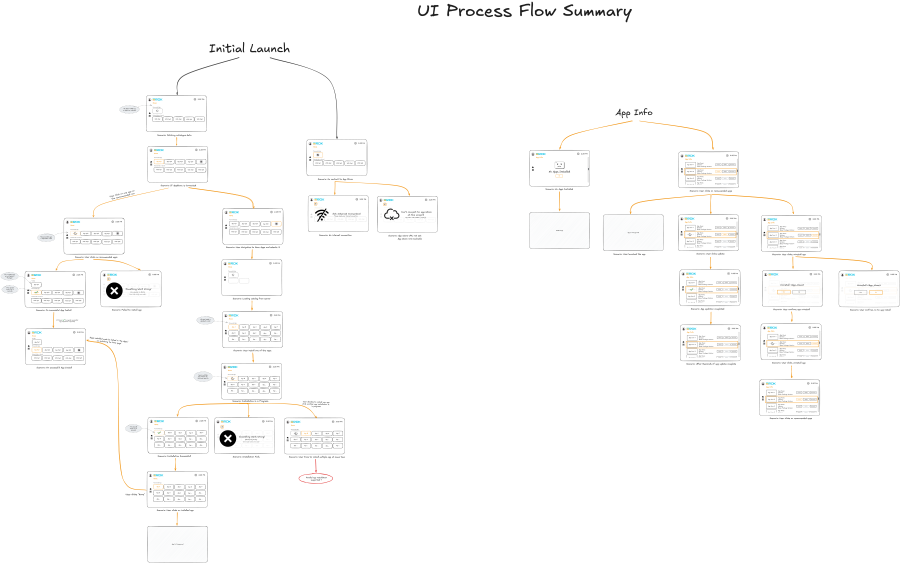
Complete UI process flow
Overview
Community Forums
Content Tools
Tasks