

Page History
State Model
...
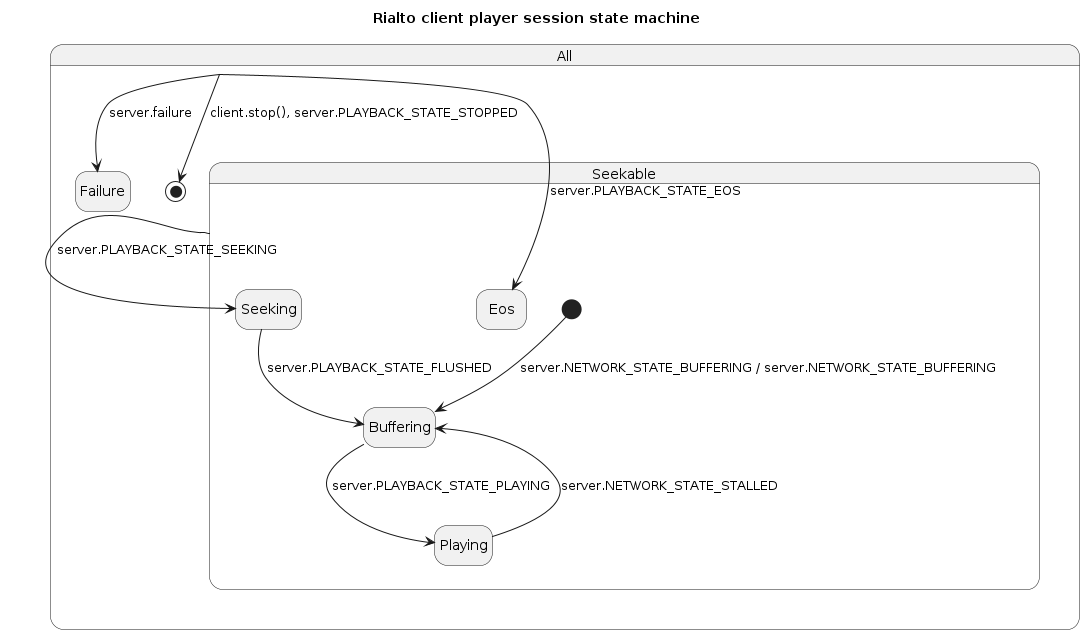
This state machine describes the state transitions per player session in the Rialto Client.
...
| format | SVG |
|---|---|
| title | sdfg |
@startuml
hide empty description
state All {
...
.
...
| PlantUML Macro | ||
|---|---|---|
| ||
@startuml


hide empty description

state All {
	All				--> Failure:	server.failure
	All				-->	[*]:		client.stop(), server.PLAYBACK_STATE_STOPPED

	state Seekable {
		[*]			-->	Buffering:      server.NETWORK_STATE_BUFFERING / server.NETWORK_STATE_BUFFERING
		Buffering	-->	Playing:		server.PLAYBACK_STATE_PLAYING
		Playing		-->	Buffering:		server.NETWORK_STATE_STALLED
		Seeking		-->	Buffering:		server.PLAYBACK_STATE_FLUSHED
		Seekable	-->	Seeking:		server.PLAYBACK_STATE_SEEKING
		All			-->	Eos:			server.PLAYBACK_STATE_EOS
	}

}

@enduml |
State diagram snapshort since PlantUML not rendering correctly above:
State Behaviour
...
The following table defines how various calls should be handled by Rialto client depending on the state of the player session:
| Rialto Client State | setPosition | haveData | needData |
|---|---|---|---|
| Buffering | Process normally | Process normally | Process normally |
| Playing | Process normally | Process normally | Process normally |
| Eos | Process normally | Unexpected, log warning & discard | Unexpected, log warning & discard |
| Seeking | Process normally | Expected, log info & discard* | Expected, log info & discard* |
| Failure | Unexpected, log warning & discard | Unexpected, log warning & discard | Unexpected, log warning & discard |
*Due to race conditions between client & server it is possible to get stale needData() & haveData() notifications and these should be ignored.
Overview
Community Forums
Content Tools
Tasks