

Page History
Architecture Overview:Status colour Green title DONE
A quick architecture overview of RDK7, to help associate the capabilities with the software stack, is given below
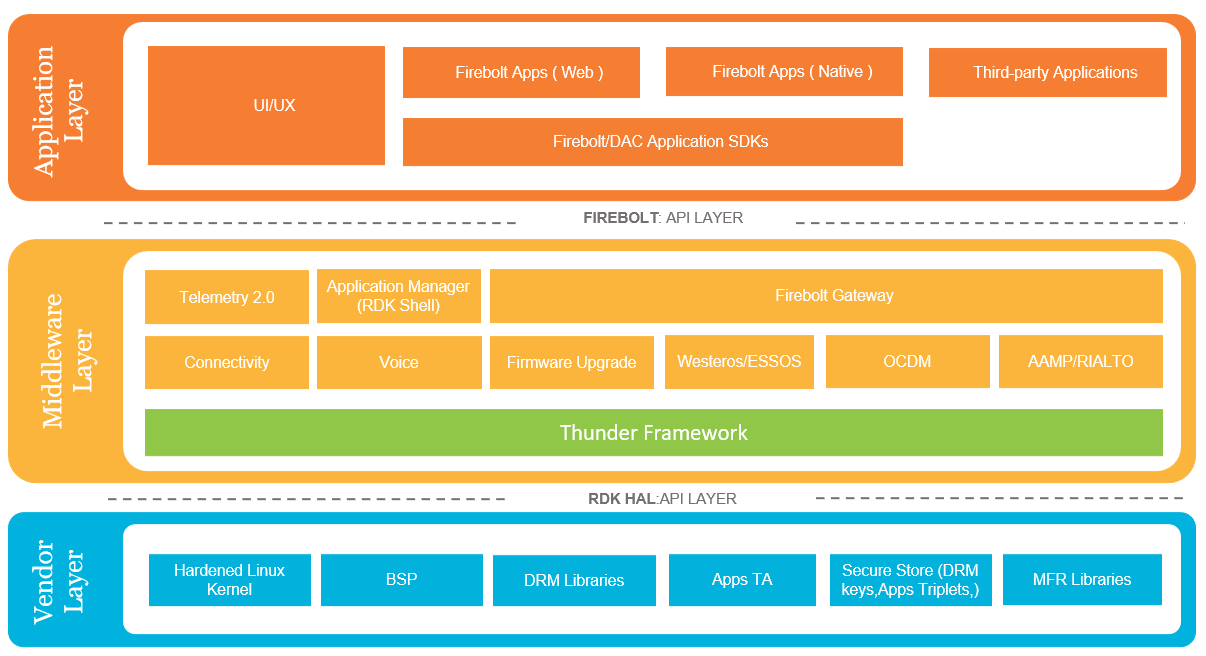
For a deep dive to the architectural changes please refer RDK7 Architecture
Build system Overview:Status colour Green title DONE
Compared to previous releases, RDK7 follows a layered build approach. The build setup is now divided into a set of independent Stack layer projects, each comprising components that are developed separately and delivered as binary packages(ipk). These stack layers are then assembled into the final image using the Image Assembler tool. The build setup maintains a Reference OSS layer, which serves as a reference Yocto distribution layer( which also includes CVE patches ), a vendor layer that contains the vendor specific code, an RDK middleware layer that contains the core RDK middleware components, and finally an application layer that contains the applications.
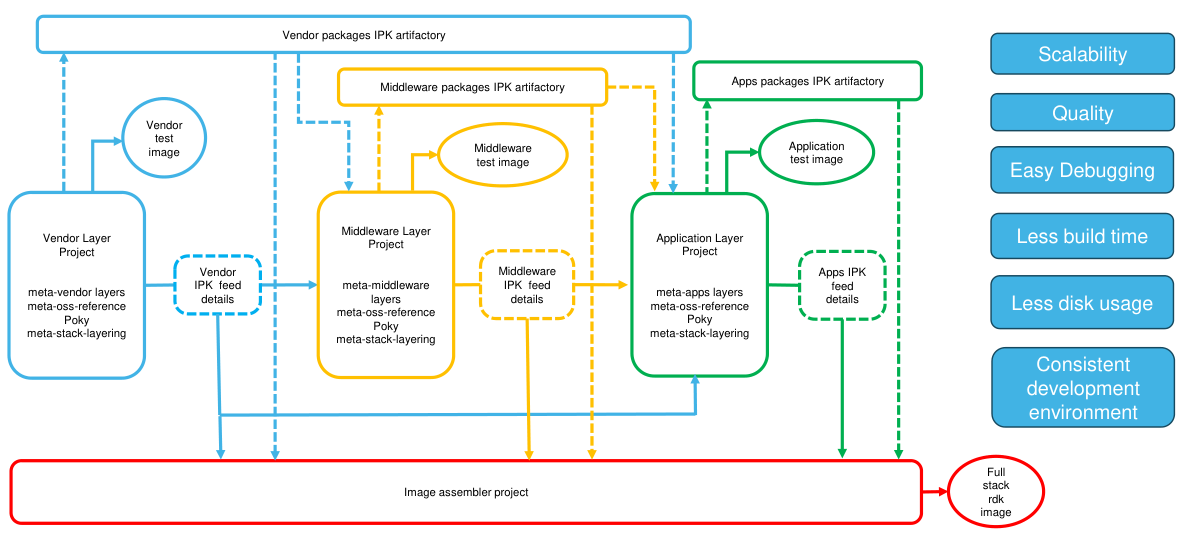
The build system introduced in RDK7 is comprehensively covered in the technical session held during the RDK Tech Summit in May 2025
|
| Note |
|---|
The session video linked below provides a technical overview of the layered build architecture designed for comprehensive RDK-E builds. This architecture is intended for future RDK releases and does not directly correspond to the current RDK7 release. The video is included as a supplementary technical resource to aid understanding of the build process. |
| HTML |
|---|
<script src=https://fast.wistia.com/player.js async></script><script src=https://fast.wistia.com/embed/3jfmbg3zlo.js async type="module"></script><style>wistia-player[media-id='3jfmbg3zlo']:not(:defined) { background: center / contain no-repeat url('https://fast.wistia.com/embed/medias/3jfmbg3zlo/swatch'); display: block; filter: blur(5px); padding-top:56.25%; }</style> <wistia-player media-id="3jfmbg3zlo" aspect="1.7777777777777777"></wistia-player> |
| Note | ||
|---|---|---|
| ||
Links to individual platforms are access restricted. Please login for better user experience. If you do not have an account, please signup at https://wiki.rdkcentral.com/signup.action . If you have logged in but not able to view the page, please contact support@rdkcentral.com |
Platforms
SupportedSupported
| Info |
|---|
For details of how to get the source code, test coverage & test report and known issues in each platform, please click the hyper link. If you do not have an account, please signup at https://wiki.rdkcentral.com/signup.action . If you are logged in but not able to view the page, please contact support@rdkcentral.com |
| Platform | Type | SOC | OEM |
|---|---|---|---|
Raspberry Pi 4 | Generic Reference device | Broadcom | Raspberry Pi Foundation |
IP STB BCM 72126 | SOC Reference device | Broadcom | NA |
IP STB AH 212 | SOC Reference device | Amlogic | NA |
IP TV AT 301 | SOC Reference device | Amlogic | NA |
IP STB 1319 Hank | SOC Reference device | Realtek | NA |
New
FeaturesFeatures
| Category | Sub -category | Version details |
|---|---|---|
| AV | Player | Gstreamer, AAMP |
| AV Pipeline | RIALTO | |
| Application Support / Prerequisites | Container | OCI Runtime + Dobby |
| Firebolt Implementation | Ripple | |
| DRM | PlayReady 4.4, Widevine v16 | |
| Connectivity | Ethernet & Wi-Fi | |
| Bluetooth | Bluetooth Bluez | |
| Remote Control | ||
| Casting | DIAL, Wi-Fi Direct (Miracast) | |
| Peripherals/Ports | HDMI, USB, Optical | |
| Framework | Thunder | Thunder 4.4 |
| Browser | WPE Webkit 2.38 | |
| Interfaces /IPC | Application Interfaces | Firebolt |
| Hardware / SOC interfaces | RDK HAL | |
| Inter Process Communication | IARM, RBUS, DBUS | |
| Protocol - Device Management | TR69hostif | |
| AV Driver interface | V4l2 | |
| Graphics and Rendering | Graphics & Rendering | OpenGL 3.2 |
| Composition | Westeros / ESSOS, Wayland | |
| Build & Platform | Kernel | ACK 5.15 64-bit Kernel |
| SOC SDK | Realtek BSP v1.2 Amlogic BSP 6.16 BCM SDK 25.1 | |
| Silicon | Broadcom, Amlogic, Realtek | |
| Build Framework | Yocto 4.0 (Kirkstone) | |
| Logging support (Debugging) | RDK Logger | |
| Firmware Upgrade | ||
| Applications | Native Apps / Runtimes | YouTube Cobalt 25 Netflix 7, Cobalt 25,Amazon AVPK6 |
| Application Management / Composition | RDKShell | |
| Application Bundle | LISA | |
| App checkpoint/restore | MemCR | |
| Access Control | AppArmor | |
| Casting | ||
| Secure Time Manager | ||
| Device management | Device Management | Web PA, XConf, Telemetry |
| Debugging |
Overview
Community Forums
Content Tools
Tasks