Versions Compared

Key

  • This line was added.
  • This line was removed.
  • Formatting was changed.

Overview 


We are pleased to introduce RDK8, the latest release of the newly restructured RDK stack. This architectural enhancement represents the next evolution of the application infrastructure, enabling platform-agnostic application delivery models.

RDK8 is released as a Development Preview to clearly signal the future direction of the platform to the RDK community, enabling operators and partners to align their roadmaps and investment plans accordingly.

Compared to the previous release, RDK8 introduces the following major architectural changes:

  • All applications are now implemented as Firebolt DAC applications, which can be independently hosted and downloaded or sideloaded onto RDK devices. The separate application layer no longer exists.
  • RDKShell is no longer used for application management. Instead, the RDK AppManager framework is used.
  • The separate OSS layer has been removed. A new OSS consumption model is introduced, where open-source packages are built as part of the vendor and middleware layers.

Please review the detailed change logs and migration guidelines provided below. We welcome community feedback as we continue to evolve the stack in alignment with open standards and industry requirements.


In this page:

Table of Contents
maxLevel4

Architecture Overview

A quick architecture overview of RDK8, to help associate the capabilities with the software stack, is given below
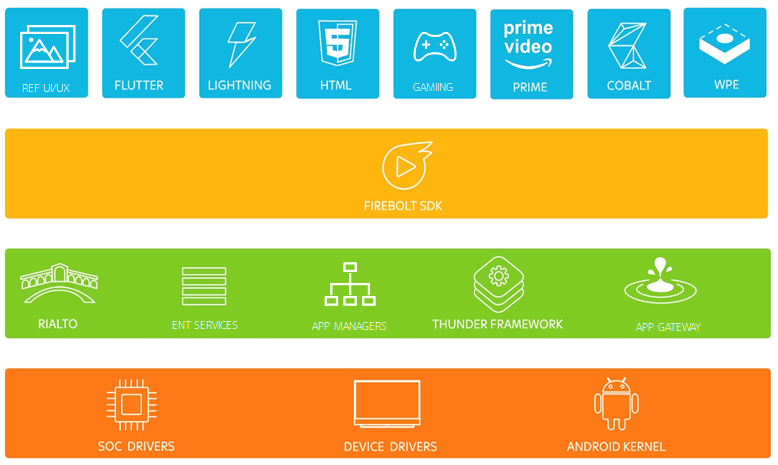
For a deep dive of the RDK architecture, please refer RDK8 Architecture


OSS Consumption Model Overview


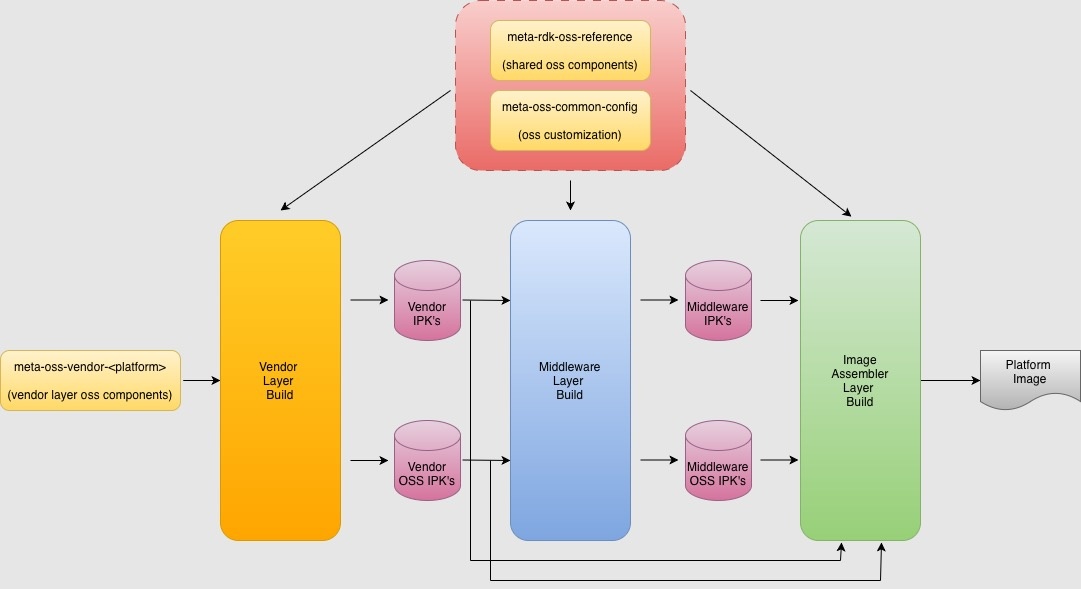
In RDK7 the OSS (OpenSource Software) components were built and delivered as IPKs. These IPKs were consumed by the RDK layers (vendor, middleware, application, image-assembler). This model lacked the flexibility of configuring an OSS component for a particular platform so a new OSS Consumption Model was introduced. RDK8 uses the new OSS Consumption Model. There is no longer a separate OSS IPK Package Feed, instead the OSS Layer is built from source in the vendor and middleware layers using the OSS reference distribution layer meta-rdk-oss-reference.

Building the vendor and middleware layers now produce two IPK feeds, one for the layer and one for the OSS components.

The middleware layer build then consumes two vendor IPK package feeds: VENDOR_IPK & VENDOR_OSS_IPK

In turn the image-assembler layer consumes the vendor and middleware IPK package feeds: VENDOR_IPK, VENDOR_OSS_IPK, MIDDLEWARE_IPK & MIDDLEWARE_OSS_IPK


Application Framework Overview

RDK8 introduces a modern, decoupled application framework that is a significant evolution from the RDK7 model. Applications in RDK8 are no longer tightly bound to the firmware image and are instead delivered as platform‑agnostic BOLT packages, enabling greater flexibility, faster iteration, and independent upgrades.

Key Highlights

  • No Application Layer: The traditional RDK7 application layer has been removed.
  • BOLT‑Based Delivery: All applications and runtimes are packaged and managed as BOLT packages.
  • Platform Agnostic: Applications are no longer built per‑platform.
  • Independent Upgrades: Base, runtime, and app components can be upgraded without flashing firmware.
  • Faster Middleware Builds: WebKit and Libcobalt are no longer part of the middleware layer.

For a detailed explanation of the RDK8 application architecture, packaging model, and migration differences from RDK7, refer to: Applications on RDK8


Note
titleAccess restrictions

Links to individual platforms are access restricted. Please login for better user experience. If you do not have an account, please signup at https://wiki.rdkcentral.com/signup.action . If you have logged in but not able to view the page, please contact support@rdkcentral.com


Platforms Supported 

Info

For details of how to get the source code, test coverage & test report and known issues in each platform, please click the hyper link. If you do not have an account, please signup at https://wiki.rdkcentral.com/signup.action . If you are logged in but not able to view the page, please contact support@rdkcentral.com

PlatformTypeSOCOEMAccess

Raspberry Pi 4

Generic Reference deviceBroadcomRaspberry Pi FoundationNo Restrictions 

IP STB BCM 74116

SOC Reference deviceBroadcomNARestricted to companies that via LDAP groups  have access to the Broadcom SoC Collaboration Repositories

IP STB RTK 1325

SOC Reference deviceRealtekNARestricted to companies that via LDAP groups  have access to the Realtek SoC Collaboration Repositories

If you require access to a release note please raise a request by emailing support@rdkcentral.com 


New Features 

A quick overview of new features/changes that made their way to RDK8 is given below

Upgrades 

New Features/ productization

  • Applications
    • YouTube (Cobalt 25)
    • AVPK 6.x
  • Application Firebolt DAC2 SDK
  • Kernel 6.1
  • SOC SDK Upgrades
  • Hardware Porting Kit
  • Vulkan Graphics
  • Application Launcher
  • Network Manager
  • RIALTO  


    For a detailed list of RDK8 new features please refer RDK8 Features