

Page History
...
To reduce the effort for user to add new test script scripts and its steps in bulk, user can import the test scripts in excel format. Click on 'Choose File' and select the excel file to be imported. Then Click on Upload File button and then Upload All Scripts. Status message of file upload will be shown in page after the upload. The imported test scripts can viewed after applying Filter option.
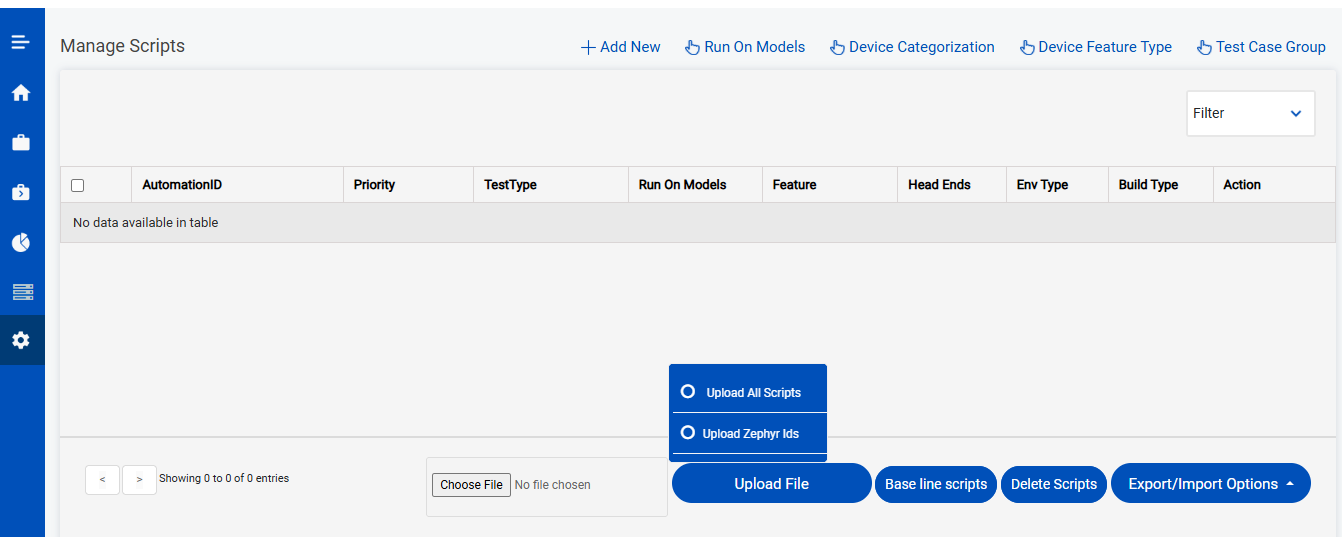
the existing excel sheet with required details. The template for the excel sheet to be used for importing the test case can be downloaded from Manage scripts page from Export/Import options menu. File picker from the Managed scripts page can be used to choose the excel sheet from the local PC and upload it to Automatics to import all the test cases and its steps in bulk
Run On Models
The Run On Models page is used to save device models which will be used for test execution. When we open the manage scripts page, over the top right we could see the Run On Models option, when we click it we will be redirected to Run On Models page. Please note that only Admin users will have access to this page.
Once we open this page we can see list of models and a button at the top right which is 'Add Device Name'.
...
Test Group
User can create test groups group and group the test scripts under a test group. This enables user to select test group for execution from Trigger Execution Manually page.
The UI provides support to add and delete test groups. Click on 'Test Case Group' link displayed in Manage Script page. This will launch the Test Case Group page from where user can view test groups, add new test group and delete test group.
...
- Please update the default value for each field here.
- For CI integration, if results of test execution to be updated to CI portal, then set 'updateRdkPortal' to true here.
- Click on Save.
Email Server configuration - SMTP
Automatics orchestration has the functionality to send email notifications. For sending an email notification an SMTP server is required. One an SMTP server is available the below are the configuration which need to be configured for sending email notification's from Automatics Orchestration. The configuration can be added via "System Configuration" page under "Settings" menu
...
The above are the configurations which should be available in Automatics for sending emails.
Automatics 3.0
New Pages are added as a part of scriptless executions Details for the following pages is provided below
API Explorer
User can get to know the API's information such as API category, Class name, API name, Applicable for, description and parameter details.
Please refer Automatics 3.0 User Manual#APIExplorer for more details.
Build Test Utility
Build Test Utility is creating the set of steps frequently used in test cases which helps in reducing the user efforts while creating test cases.
Please refer Automatics 3.0 User Manual#BuildTestUtility for more details.
Test Constants
Tests Constants in automatics 3.0 is used to provide a feasible option for test developer to add a key value pair where the value can accessed any where in the test case by providing the key value.
Please refer Automatics 3.0 User Manual#TestConstants for more details on how to create and use test constants in test cases.
Build Test Case
Scriptless test cases can be build in Build test case page.
Please refer Automatics 3.0 User Manual#BuildTestCase for more details on how to build 3.0 test cases.
Execute Tests using Smart Debugger Feature
In step builder page at the top, developer can find a debugger icon. Click on the icon to open the testcase debugger popup.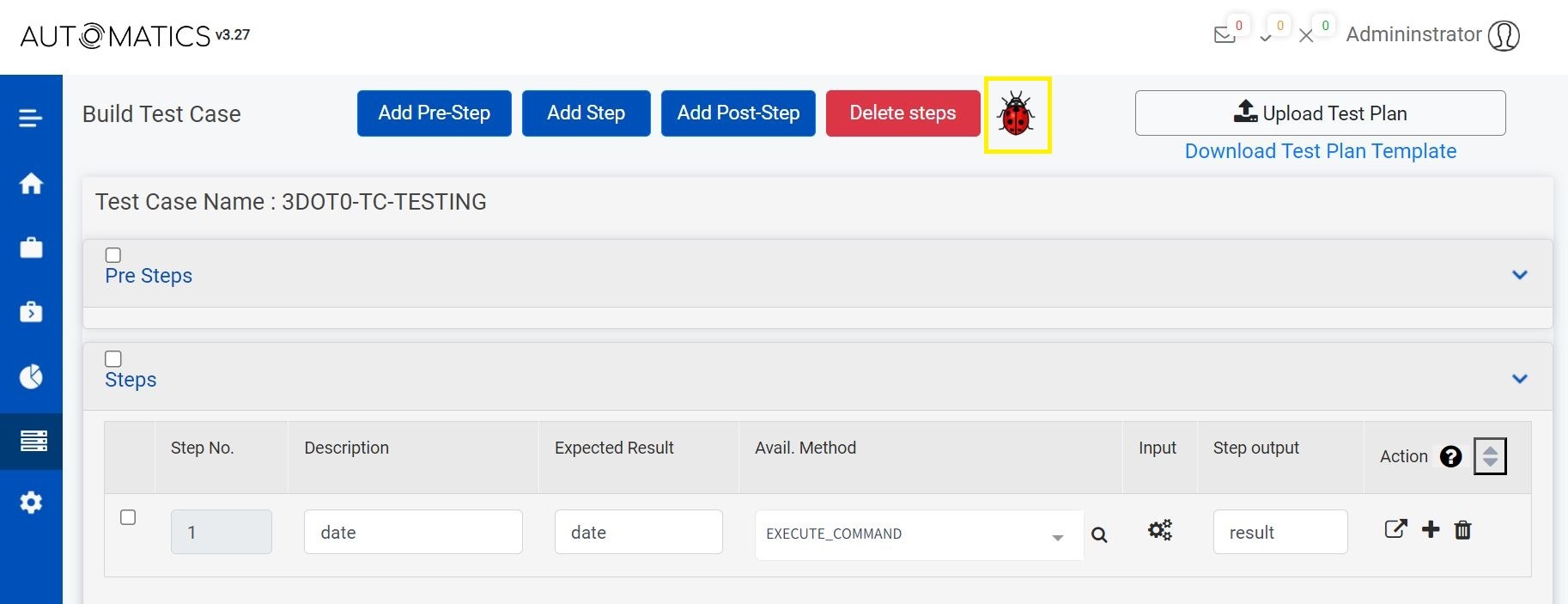
2. In the debugger popup, developer can see configuration options to start the execution.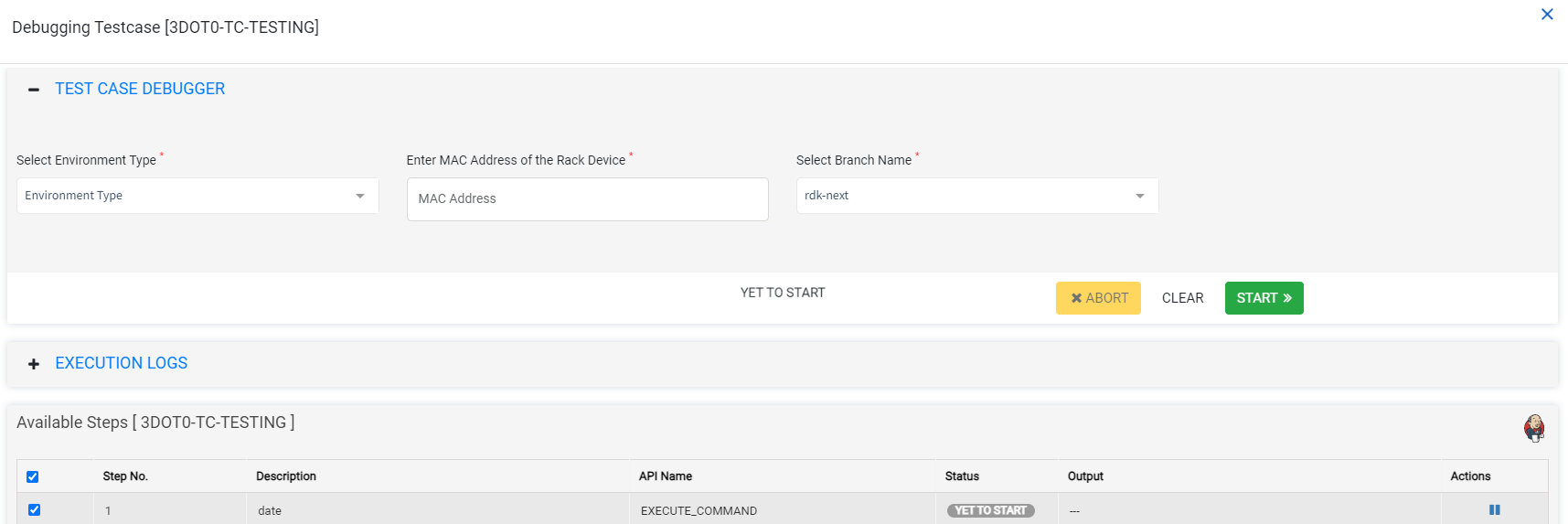
After starting the execution, click on EXECUTION LOGS panel to see the execution logs.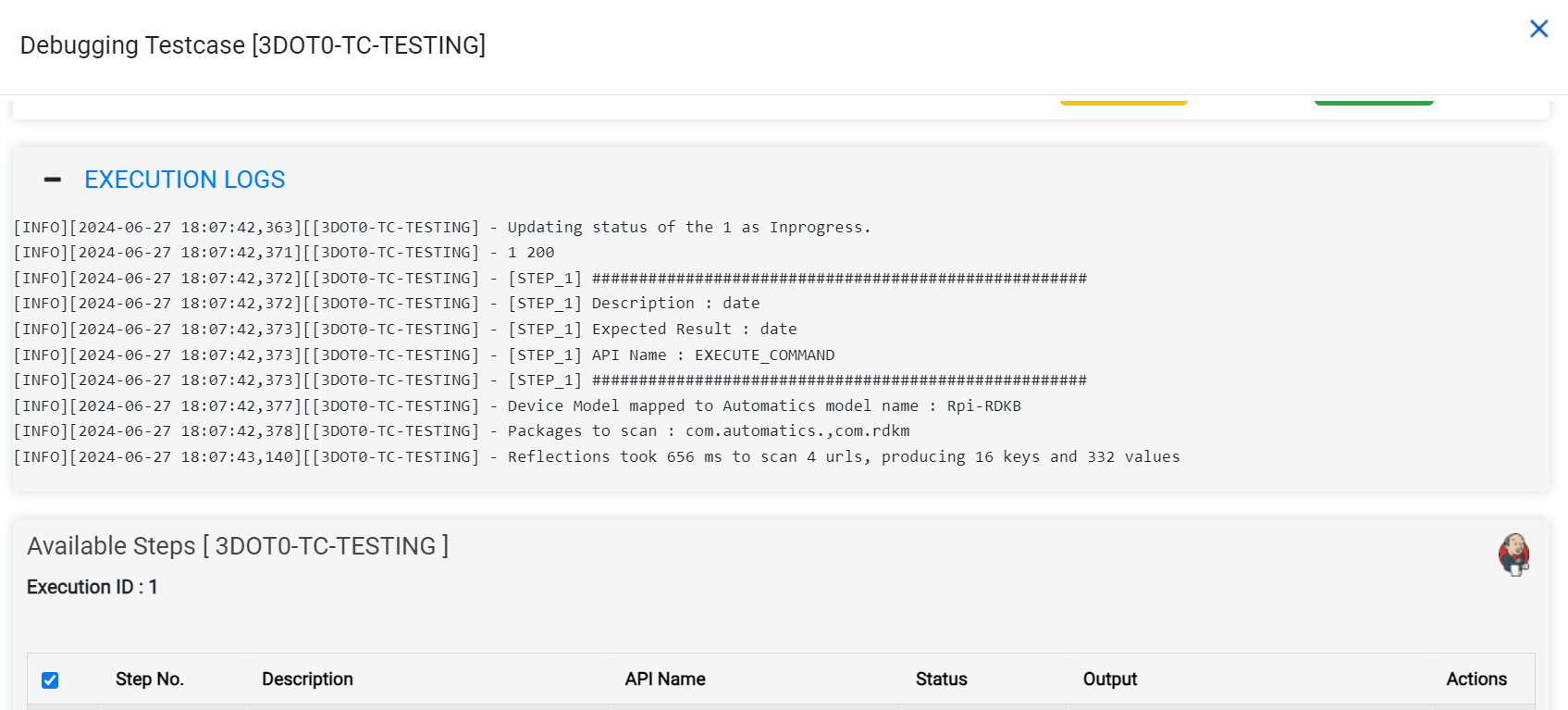
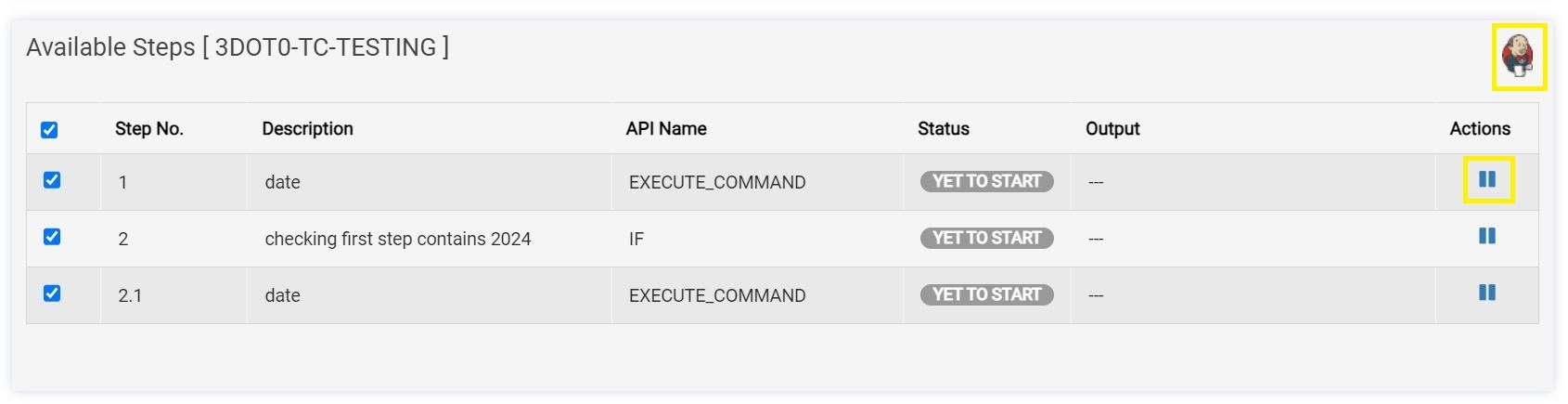
3. At the bottom of the page, automation developer can see the available steps from the testcase loaded in table.
4. Functionalities:
Status involved in step execution:
* YET_TO_START
* IN_PROGRESS
* PAUSED
* PASS
* FAIL
* Output: Step output will be added in output column of the table.
* By using Checkboxes at the left side, automation developer can select/unselect the steps for the execution. So, if automation developer wants to execute sepecific steps they can select the steps on demand for the execution.
* Click on PAUSE button to pause the execution and use the PLAY button to resume the execution.
* Automation Developers can see the Jenkins execution logs using the Jenkins icon at the top right corner.
For the test execution team, separate dashboard was there under Manage Test Trigger menu. This option is available under Manage Test Trigger tab → Test Case Debugger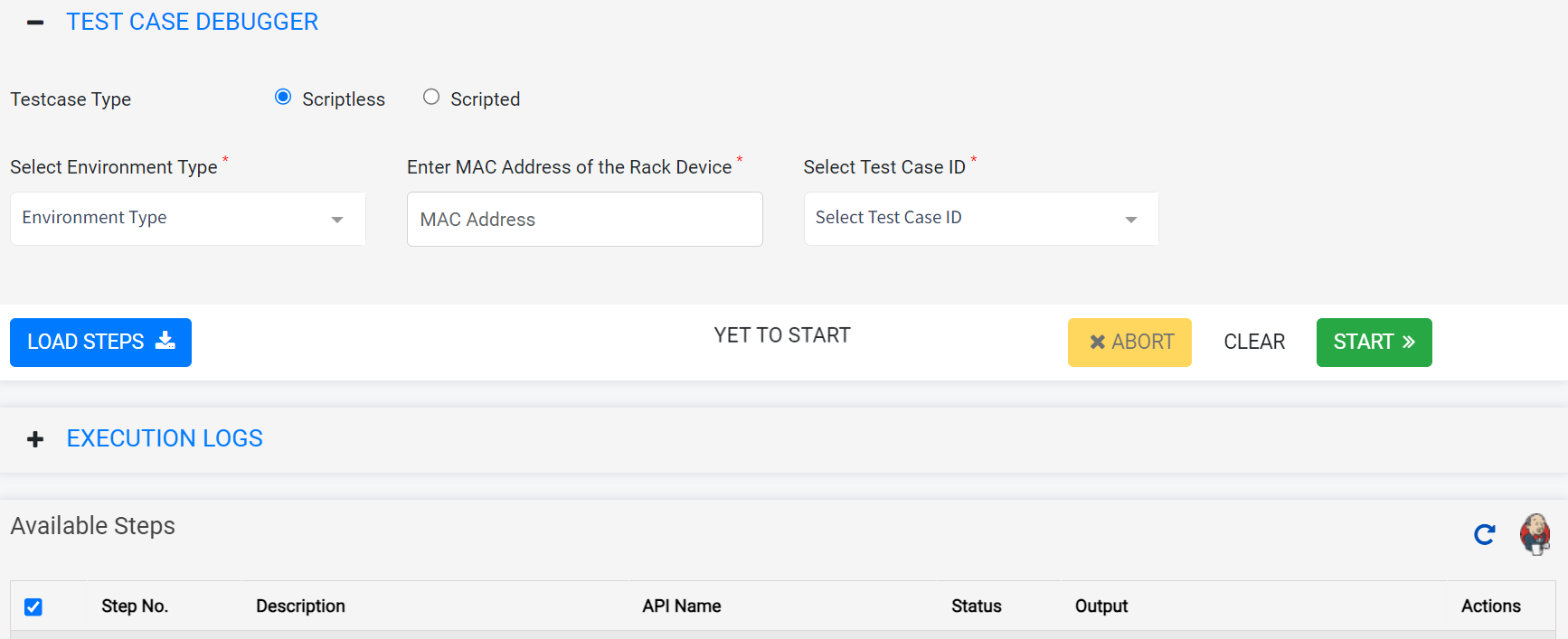
To start the debugger execution, please follow the below steps:
1. Select Testcase Type
* Scriptless - To load the Scriptless testcases (i.e. created from Build Testcase page)
* Scripted - To load the scripted testcases (i.e. Testcases that has its own scripts in Test projects).
2. Select Environment Type and enter valid Device Mac of the Rack Device.
3. Upon the previous inputs Testcase IDs will be populated in Test case ID select box. Select the test case from the drop down.
4. After giving all the inputs click on Load Steps button at the left side.
5. After loading the steps into the table present in Available Steps division, click on the START button to start the execution.
Review 3.0 Test Scripts from Review Dashboard
Follow below steps to perform review of 3.0 Test Scripts from dashboard
- Navigate to Automatics Menu -> Test Manager-> Review Dashboard.
- Here everyone will be able to see the reviews with all the testcase details, developer, assigned reviewer, and review status.
- To review a test case, choose the test case and click on Actions -> Review.
- User can review the testcase details by using the Review option. It will redirect the user to the testcase in Build Test Case. Their user can review the testcase and can add comments about the development or any change needs to be done, etc.
- To change the status of the test case, choose the test case and click on Actions -> Change status.
- According to test case developer's point of view, they will be able to change the status to REWORK or ABANDONED.
- According to test case reviewer's point of view, they will have the authority to change the status to APPROVED, MERGED, REWORK or ABANDONED.
- You can also add notes to a review, to add a note choose the test case and click on Actions -> Add Notes
- The test case developers or the reviewer can add comments to the review by using the Add Notes option.
Overview
Community Forums
Content Tools
Tasks