You are viewing an old version of this page. View the current version.
Compare with Current
View Page History
« Previous
Version 7
Next »
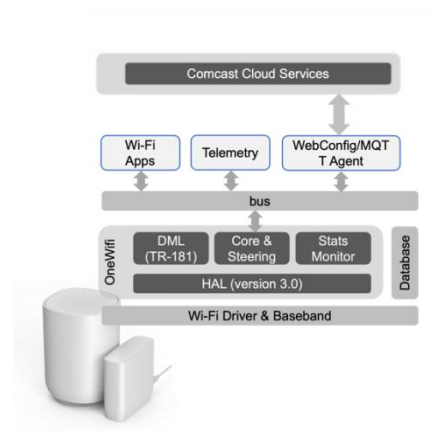
Unified (One)Wifi is an 802.11 protocol stack designed for the configuration, statistics, steering, and telemetry of Wi-Fi driver and basebands. It has been architected based on years of experience addressing field and deployment challenges. The implementation is largely generic due to the use of open-source modules (hostap) and Linux libraries (netlink, cfg80211), enabling the stack to operate seamlessly across multiple Wi-Fi chipsets and ensuring easy portability to new devices. The stack supports various management protocols, including WebConfig, TR-181, WFA Data Elements, and TR-181 USP. Additionally, it also supports wide range of Wi-Fi applications, such as motion detection, device typing, connection admission control, and EasyMesh.
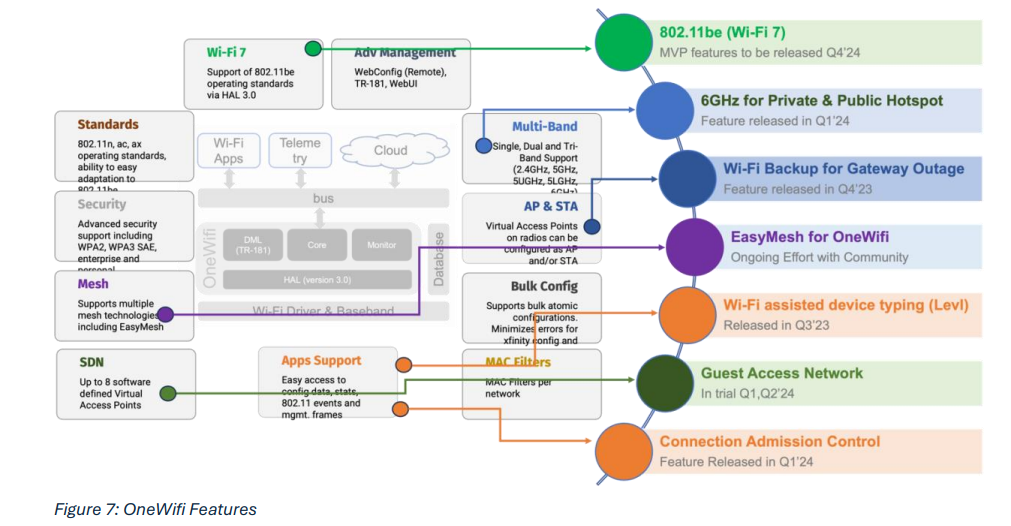
OneWifi is rich in features. As depicted in Figure 7: OneWifi Features the list of features includes 802.11be, 6GHz Private & Public Service, EasyMesh, Connection Admission Control etc.
ToDo features and roadmap details - will be shared by soumya munshi
Along with its rich content of features, OneWifi offers significant benefits to adopters.
OneWifi is built primarily of OpenSource code that are widely deployed in huge scale. Since such code had been vetted for wide usages, new defects are less, and existing defects are well published with fixes already available.
Faster End-2-End Feature Development
OneWifi code is mostly generic, and platform specific differences are abstracted by limited number of HAL functions. Because of generic common business logic, development of features set can be fast. Code for new feature can be developed on a primary platform and tested on other platforms.
Faster Triage and Field Defects Debugging
OneWifi implements detailed logging and real time events visualization capabilities. Along with regular informative log files that are periodically uploaded to Cloud, there are a couple of different ways to triage and debug field issues.
Enablement of Module Specific Logging
The following modules of OneWifi can be debugged in detail by writing the following tokens under /tmp (“touch /tmp/<token_name>”)
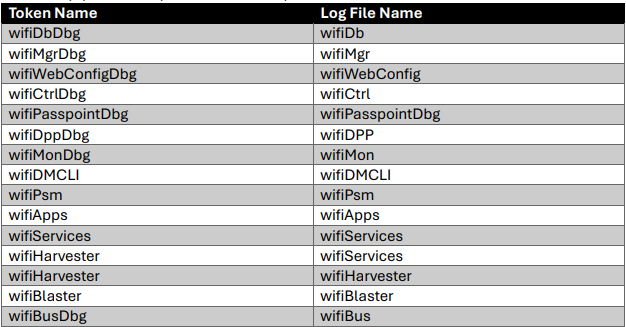
It is to be noted that after debugging is complete, the token needs to be removed from the /tmp directory to resume normal operation of the system.
Enablement of Events Visualization
OneWifi automatically logs important real time events in /rdklogs/logs/wifiAnalytics.txt. This file is in UML format and can be post processed by any UML reader to give a real time like events transfer visualization. This feature is very helpful to debug client device specific connection issues or related problems.
OneWifi uses Linux provided native libraries function calls to interact with lower layer Wi-Fi drivers. These function calls are fundamentally built around cfg80211 and mac80211 specifications which are supported in Linux distributions via netlink library functions. If the SoC vendor driver is cfg80211 & mac80211 compliant, it is very likely that OneWifi will automatically run on the new SoC without any significant porting effort of Wi-Fi HAL library functionalities.


